Skip to content

Categories: employment and labour markets

  • Regulating platform work in Europe: A work in progress

    Eurofound research has demonstrated that existing initiatives often fail to provide both platform workers and platform companies with the regulatory predictability and legal certainty needed for ensuring good working conditions and a level playing field.

  • Trust in national institutions is falling: Data behind the decline

    Trust in national institutions has declined across the EU over the past two years. Driven by increasingly difficult economic circumstances and unreliable news sources, even people who previously expressed higher trust levels – such as those in financially secure positions – have become less trusting. We take a closer look at e-survey data to explore this decline in trust.

  • Real minimum wages declined in most EU Member States

    Against the background of inflation affecting European countries, minimum wage workers in 15 out of 21 Member States with statutory minimum wages registered a decline in their wages in real terms between 1 January 2021 and 1 January 2022. This was despite comparatively large increases in nominal rates in the EU during the period.

  • Eurofound and IIEA discuss labour market change and future of work

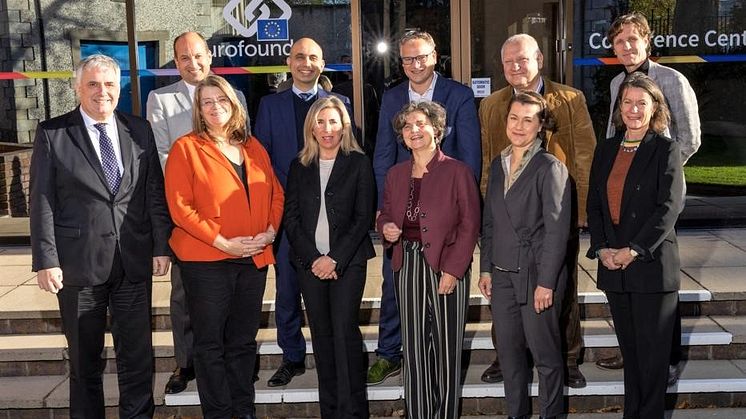
    The Directors and senior staff of Eurofound and the Institute of European Affairs (IIEA) met at Eurofound, Dublin this week, following the recent appointment of David O’Sullivan as the Director General of IIEA. It was an opportunity to review ongoing collaboration between the two organisations, as well as discuss latest research; including on the economic, employment and social impacts of the COVI

  • Bulgaria noted impressive progress in poverty reduction and meeting medical needs prior to COVID-19 pandemic

    Between 2008 and 2019, reported unmet medical needs in Bulgaria declined from 22.4% to 2.4%. One year after the country’s accession to the EU in 2007, Bulgaria had ranked last among the group of Member States but caught up by 2019 to perform above the EU average at 3.1%. Similarly, the AROPE rate, which is the number of people who are at risk of poverty, severely materially deprived, or living in

  • Lithuania looks to re-establish pre-pandemic progress

    In the decade prior to the COVID-19 pandemic Lithuania had a steady increase in unweighted average disposable income, recording the largest increases alongside Romania. It also recorded the lowest gender employment gap in the EU in 2019. Like other Member States, however, the pandemic has set Lithuania back in a number of labour market and social indicators, and in particular it saw a rise in unem

  • Eurofound welcomes European Year of Youth 2022

    Eurofound welcomes European Year of Youth 2022 #EYY2022. The situation of young people in the EU has long been an important focus for Eurofound’s work. Eurofound remains committed to continuing its work to provide policymakers with the most timely, relevant and reliable data and research to address the challenges facing young people.

  • Finland has highest teleworking rate in the EU before and during the pandemic

    Almost one in four workers (22.4%) in Finland usually worked from home during 2020, according to new analyses published in Eurofound’s recent research report What just happened? COVID-19 lockdowns and change in the labour market. This is the highest proportion across the EU, where the average is 10.8%. All Member States reported an increase of teleworking during 2020, but the largest increases (in

  • Romania keeps youth unemployment below EU average

    In 2020, the youth unemployment ratio in Romania was 5.5%, while the EU27 average stood at 7.1%. This ratio, which notes number of unemployed young people as a proportion of the total population of that age group, increased in almost all EU Member States between 2019 and 2020. In Romania, specifically, the figure rose from 4.8%, while the EU average increased from 6.5%.
    This data was recently

  • High levels of optimism about future among young people in Latvia

    Despite the disproportionate impacts of the COVID-19 pandemic on young people in the EU, Latvia has managed to retain a comparatively high level of optimism among its younger population, with 70% of people aged 18-29 in the country optimistic about their future. This is the second highest optimism score in the EU during spring 2021, only behind Malta, while the EU27’s average is 49% of young peopl

  • Poland records longest annual working hours in the EU in 2020

    Employees in Poland are working 1,848 hours per year, the highest annual working hours figure (alongside Hungary) across the EU. The shortest hours are found in Germany (1,574 hours), France (1,610 hours) and Denmark (1,635 hours). These figures are part of Eurofound’s Working time in 2019–2020 report, which documents the most relevant changes in working time regulation after the onset of the COVI

  • Decrease of working hours and trust in national government marking COVID-19 impact in Czechia

    In quarter four of 2020, weekly working hours in Czechia decreased by 2.8 hours, marking the largest decrease in the EU in a year-on-year comparison with the same period of 2019 and followed by Austria (-1.8 hours per week). The EU’s average for the end-of-year quarter lies at -0.5 hours. This data was recently published in a joint Eurofound and European Commission report (What just happened? COVI

  • Österreich verzeichnet die höchste Arbeitszeitverkürzung und einen starken Vertrauensverlust in die nationale Regierung während COVID-19

    Die wöchentliche Arbeitszeit in Österreich hat sich zu Beginn der COVID-19 Pandemie (2. Quartal 2020) im Vergleich zum Vorjahreszeitraum um 2,6 Stunden verringert. Dies war der größte Rückgang in der EU und liegt über dem EU-Durchschnitt von -0,9 Stunden, wie aus einem gemeinsamen Bericht von Eurofound und der Europäischen Kommission hervorgeht (Was ist gerade passiert? COVID-19-Sperren und Veränd

  • Austria notes highest decrease of working hours and sharp decrease in trust in national government during COVID-19

    Weekly working hours in Austria decreased by 2.6 hours at the onset of the COVID-19 pandemic (quarter 2 2020) as compared to the same time of the previous year. This was the largest decrease in the EU and far beyond the EU average of -0.9 hours, as reported by a joint Eurofound and European Commission report (What just happened? COVID-19 lockdowns and change in the labour market), which describes

  • Workers on temporary contracts bore brunt of COVID-19 job loss

    Temporary workers, particularly those in non-teleworkable occupations such as services and sales jobs, elementary occupations and blue-collar occupations, were disproportionately impacted by COVID-19 job loss in Europe, accounting for three-quarters of net job loss in the EU in 2020.

  • 92% of Slovakian companies report difficulties in recruiting adequately skilled employees, amid high youth unemployment

    More than 9 out of 10 establishments with 10 or more employees in Slovakia report difficulties in finding suitable candidates for open positions, according to a recent Eurofound report on ‘Tackling labour shortages in EU Member States’. This is the highest proportion in the EU, followed by Romania (90%) and Malta (88%), while rates are lowest in Denmark and Greece (both 57%).

  • Belgium records relatively low number of job losses during COVID-19 pandemic

    In spring 2021, around 5% of people in Belgium, who had been employed before the pandemic, reported having lost their job. Compared to the EU average of 10%, Belgium fares comparatively well, with only neighbouring Luxembourg and the Netherlands reporting lower figures, according to Eurofound’s large-scale Living, working and COVID-19 online survey.

Show more